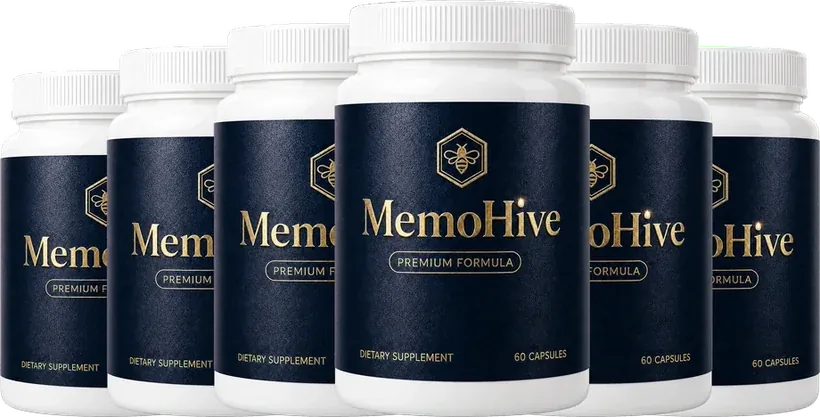
What is really in MemoHive, milligram by milligram
Five ingredients, five printed amounts, and one of them takes up more than half the serving. A straight read of the label.
Reviewed September 2026 · every figure taken from the seller’s own published MemoHive pages
Most supplements in this category hand you a blend name and one number. MemoHive does not: it prints a milligram figure beside all five of its ingredients. That is worth applauding, and it is also what makes the rest of this article possible.
Here is the panel, per two-capsule serving.
Branched chain amino acids 2:1:1 — 540 mg
Fifty-two per cent of the serving. BCAAs are leucine, isoleucine and valine in a 2:1:1 ratio, and they are the staple of sports nutrition, where people take them around training.
They are perfectly real amino acids. They are simply not what anybody has in mind when they buy a capsule with a bee on the label. If you have been taking a protein shake, you are already getting these.
Bacopa Monnieri Extract — 200 mg
The ingredient with the best claim to the front of this bottle. Bacopa has centuries of use in Ayurvedic practice for memory and it is among the better-studied herbs in the category.
Two things to know. The dose matters — trials often use somewhere near 300 mg, so 200 mg sits below that. And the timeline matters more: bacopa studies generally run eight to twelve weeks before they measure anything. It is the opposite of a supplement you feel on Tuesday.
Rhodiola Rosea Extract — 100 mg
An arctic adaptogen, researched mostly around mental fatigue rather than memory itself. If anything in this bottle gets noticed in the first fortnight, it is likely to be this, and what gets noticed is usually described as being less worn out rather than remembering more.
L-Theanine — 100 mg
The calming ingredient, found naturally in tea. It is normally paired with caffeine to smooth the edges off; MemoHive has no caffeine, so here it works alone.
That is an interesting formulation choice. A focus product whose fourth ingredient is a relaxant is aiming at settled attention rather than stimulation.
Panax Ginseng Extract — 90 mg
The smallest figure on the panel. Panax is the ginseng species with actual research behind it, which is worth checking on any label, because plants sold as plain "ginseng" are frequently a different genus. This one names the species properly.
What the split actually says
Add the four botanicals together and you get 490 mg. Add the amino acids and you get 540 mg. So more of the serving is going to the sports-nutrition ingredient than to everything else combined.
Is that a reason not to buy it? Not necessarily. 490 mg of named, dosed botanicals is a real formula, and the disclosure is better than most competitors manage. But it does mean the serving size sounds more substantial than the memory-focused part of it really is, and you should go in knowing that.
What is not in it
No ginkgo biloba, no phosphatidylserine, no vitamin B12, no citicoline, no lion's mane and no caffeine.
We list those specifically because several pages selling MemoHive claim the first three. They are not on the panel. If a page describing this bottle mentions ginkgo, it is describing something else.
The capsule itself
Cellulose — a vegetable shell rather than gelatin. Worth knowing if that matters to you.
MemoHive in short
- Two capsules a day, 60 to a bottle
- Five ingredients, every amount printed
- 1,030 mg per serving
- No caffeine on the panel
- From $49 a bottle, 60-day guarantee
Keep reading